Palestinian Territory · Population

On this page you can find past, current and future population statistics for Palestinian Territory (from 1950-2100), population map, demographics, live population counter etc. . Question: What is the population of Palestinian Territory? Answer: Current population of Palestinian Territory is: 6 079 626*[1], area 5970 km², population density 1018.36 p/km². Capital of Palestinian Territory is East Jerusalem. Continent: Asia.

Palestinian Territory · Population 1950-2100

Palestinian Territory · historical and predicted populations (both sexes) for the period 1950-2100 (millions) De facto population in Palestinian Territory as of 1 July of the year indicated. Source United Nations Population Division [1].

What was the Palestinian Territory population at your birthday?*

Enter your birth date to find out. [1]

year:***
month:
day:

Current Palestinian Territory population

6 079 626

Today This year
Population growth Today
xx
Changes every 245.567 sec.
Population growth This year
xx
Births Today
xx
Changes every 215.781 sec.
Births This year
xx
Deaths Today
xx
Changes every 1778.948 sec.
Deaths This year
xx

Sources: [1]
Today's statistic since midnight 00:00.
This year, statistic changes since 1st January
Population = Births** - Deaths

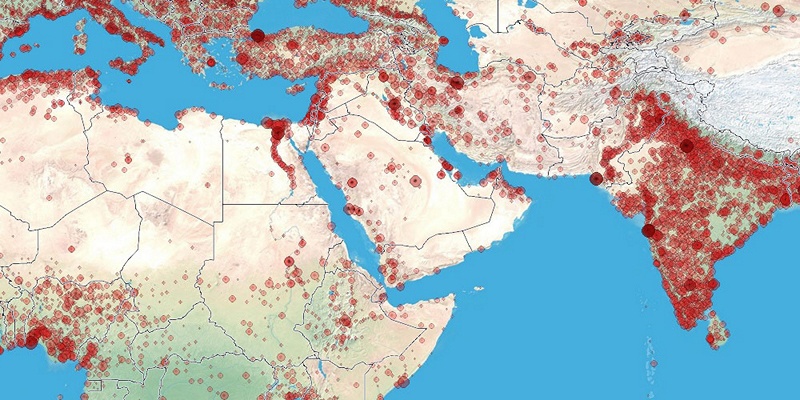
Palestinian Territory population map

City density [2]population density [3]Legend (Click on marker to hide it)
• Population Growth rate: 352 / day = 14.66 / hour = 0.244 / minute = 0.0041 / seconds
• Births Growth rate**: 401 / day = 16.72 / hour = 0.274 / minute = 0.0046 / seconds
• Deaths Growth rate: 49 / day = 2.02 / hour = 0.034 / minute = 0.0006 / seconds.

Current Palestinian Territory population by age and sex for 2026-06-23*

  Male % Female
0-4 445 603 ⇐+4.8% 425 174
5-9 398 324 ⇐+4.3% 381 862
10-14 328 832 ⇐+4.1% 315 867
15-19 292 417 ⇐+4.1% 280 951
20-24 319 096 ⇐+4% 306 747
25-29 301 561 ⇐+3.9% 290 246
30-34 222 591 ⇐+3.6% 214 790
35-39 177 919 ⇐+3.3% 172 298
40-44 149 725 ⇐+2.6% 145 996
45-49 120 140 ⇐+1.6% 118 203
50-54 106 781 +0.3%⇒ 107 145
55-59 81 275 +1%⇒ 82 053
60-64 44 422 +16.2%⇒ 51 630
65-69 32 858 +20.9%⇒ 39 734
70-74 30 263 ⇐+9.1% 27 749
75-79 15 381 +25.5%⇒ 19 301
80-84 9 259 +27.9%⇒ 11 842
85-89 3 703 +35%⇒ 4 999
90-94 873 +88.1%⇒ 1 642
95-99 96 +177.1%⇒ 266
100+ 2 +200%⇒ 6

Sources: [1]

Ads

age of mother

Childrens per woman

Life expectancy at birth

Sources, Notices

* Value is calculated with linear interpolation from 2 nearest estimated (date->population) data (unofficial).
** Net migration is included in Births with this calculation: Births = Population[1] + Deaths[1].
*** For years before 1950 we dont have population data. Value is approximate calculation using function: 1900 population = 70% of 1950 population.
[1] United Nations, Department of Economic and Social Affairs, Population Division (2015). World Population Prospects: The 2015 Revision. Data are estimates and projections according to a medium-fertility variant. Reused with the permission of the United Nations. Downloaded: 2015-11-15 (un.org)
[2] City density map, generated by population.city using data provided to us by 1km.net website. Every circle is city with population over 5000. Link
[3] Population density map generated by instructions from daysleeperrr on reddig. Link1. Used data source is the Gridded Population of the World (GPW), v3 online at the the Socioeconomic Data and Applications Center (SEDAC) at Columbia University. Link2. Additional urban land cover: Extracted from Global Land Cover Characteristics Data Base Version 2.0 and Binary MOD12Q1 data on shadedrelief.com. Link3 (PNG,0.5Mb).