North Korea · Population

On this page you can find past, current and future population statistics for North Korea (from 1950-2100), population map, demographics, live population counter etc. . Question: What is the population of North Korea? Answer: Current population of North Korea is: 26 578 900*[1], area 120540 km², population density 220.5 p/km². Capital of North Korea is Pyongyang. Continent: Asia.

↓ Population for cities ↓  

North Korea · Population 1950-2100

North Korea · historical and predicted populations (both sexes) for the period 1950-2100 (millions) De facto population in North Korea as of 1 July of the year indicated. Source United Nations Population Division [1].

What was the North Korea population at your birthday?*

Enter your birth date to find out. [1]

year:***
month:
day:

Current North Korea population

26 578 900

Today This year
Population growth Today
xx
Changes every 250.952 sec.
Population growth This year
xx
Births Today
xx
Changes every 86.149 sec.
Births This year
xx
Deaths Today
xx
Changes every 131.183 sec.
Deaths This year
xx

Sources: [1]
Today's statistic since midnight 00:00.
This year, statistic changes since 1st January
Population = Births** - Deaths

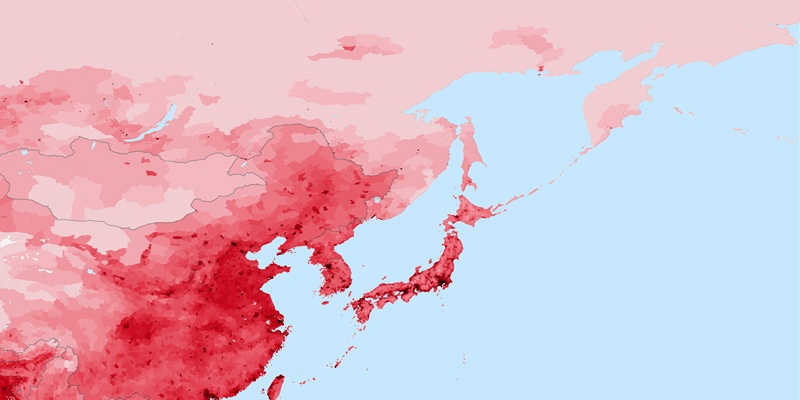
North Korea population map

City density [2] • population density [3] • Legend (Click on marker to hide it)
• Population Growth rate: 344 / day = 14.35 / hour = 0.239 / minute = 0.004 / seconds
• Births Growth rate**: 1003 / day = 41.74 / hour = 0.697 / minute = 0.0116 / seconds
• Deaths Growth rate: 659 / day = 27.44 / hour = 0.457 / minute = 0.0076 / seconds.

Current North Korea population by age and sex for 2026-10-25*

  Male % Female
0-4 1 076 774 ⇐+3.9% 1 036 522
5-9 778 399 ⇐+5% 741 222
10-14 762 390 ⇐+3.3% 737 957
15-19 891 904 ⇐+4.1% 856 530
20-24 1 030 357 ⇐+5.4% 977 513
25-29 1 055 265 ⇐+3.4% 1 020 141
30-34 1 142 696 ⇐+2.8% 1 111 040
35-39 674 810 ⇐+4.1% 647 990
40-44 386 473 ⇐+3.9% 371 952
45-49 1 472 704 ⇐+0.7% 1 461 924
50-54 1 172 418 +0.4%⇒ 1 176 627
55-59 900 193 +8.9%⇒ 980 393
60-64 881 334 +5.8%⇒ 932 703
65-69 64 987 +103.9%⇒ 132 493
70-74 328 083 +47.2%⇒ 482 782
75-79 242 023 +73.4%⇒ 419 617
80-84 132 587 +127.4%⇒ 301 521
85-89 22 532 +442%⇒ 122 134
90-94 3 842 +1016.4%⇒ 42 893
95-99 588 +647.1%⇒ 4 393
100+ 20 +745%⇒ 169

Sources: [1]

Ads

age of mother

Childrens per woman

Life expectancy at birth

Population for cities or regions in North Korea (27)

Anju South Pyongan
♥ Chongjin North Hamgyong
Chongju North Pyongan
Haeju South Hwanghae
♥ Hamhung South Hamgyong
Hoeryong North Hamgyong
Huichon Chagang
Hyesan Ryanggang
Kaechon South Pyongan
Kaesong North Hwanghae
Kanggye Chagang
Kimchaek North Hamgyong
Kusong North Pyongan
Manpo Chagang
Munchon Kangwon
♥ Nampo South Pyongan
Pyongsong South Pyongan
♥ Pyongyang Pyongyang
Rason North Hamgyong
Sariwon North Hwanghae
Sinpo South Hamgyong
♥ Sinuiju North Pyongan
Songrim North Hwanghae
Sunchon South Pyongan
Tanchon South Hamgyong
Tokchon South Pyongan
♥ Wonsan Kangwon

Sources, Notices

* Value is calculated with linear interpolation from 2 nearest estimated (date->population) data (unofficial).
** Net migration is included in Births with this calculation: Births = Population[1] + Deaths[1].
*** For years before 1950 we dont have population data. Value is approximate calculation using function: 1900 population = 70% of 1950 population.
[1] United Nations, Department of Economic and Social Affairs, Population Division (2015). World Population Prospects: The 2015 Revision. Data are estimates and projections according to a medium-fertility variant. Reused with the permission of the United Nations. Downloaded: 2015-11-15 (un.org)
[2] City density map, generated by population.city using data provided to us by 1km.net website. Every circle is city with population over 5000. Link
[3] Population density map generated by instructions from daysleeperrr on reddig. Link1. Used data source is the Gridded Population of the World (GPW), v3 online at the the Socioeconomic Data and Applications Center (SEDAC) at Columbia University. Link2. Additional urban land cover: Extracted from Global Land Cover Characteristics Data Base Version 2.0 and Binary MOD12Q1 data on shadedrelief.com. Link3 (PNG,0.5Mb).