Ecuador · Population

On this page you can find past, current and future population statistics for Ecuador (from 1950-2100), population map, demographics, live population counter etc. . Question: What is the population of Ecuador? Answer: Current population of Ecuador is: 18 874 897*[1], area 283560 km², population density 66.56 p/km². Capital of Ecuador is Quito. Continent: Latin America, Caribbean.

↓ Population for cities ↓  

Ecuador · Population 1950-2100

Ecuador · historical and predicted populations (both sexes) for the period 1950-2100 (millions) De facto population in Ecuador as of 1 July of the year indicated. Source United Nations Population Division [1].

What was the Ecuador population at your birthday?*

Enter your birth date to find out. [1]

year:***
month:
day:

Current Ecuador population

18 874 897

Today This year
Population growth Today
xx
Changes every 131.166 sec.
Population growth This year
xx
Births Today
xx
Changes every 96.79 sec.
Births This year
xx
Deaths Today
xx
Changes every 369.321 sec.
Deaths This year
xx

Sources: [1]
Today's statistic since midnight 00:00.
This year, statistic changes since 1st January
Population = Births** - Deaths

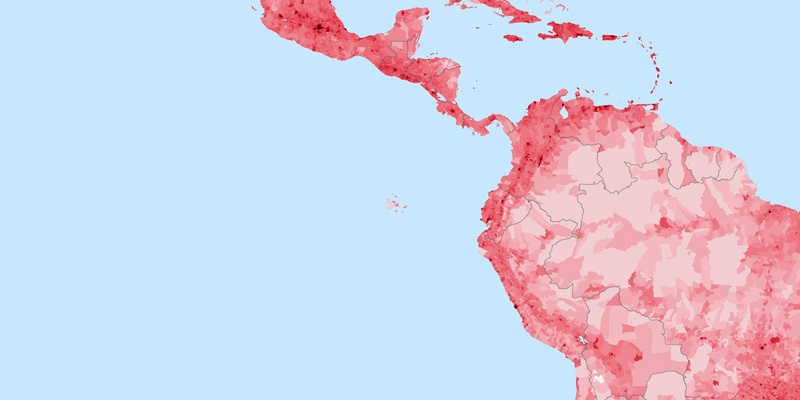
Ecuador population map

City density [2] • population density [3] • Legend (Click on marker to hide it)
• Population Growth rate: 659 / day = 27.45 / hour = 0.457 / minute = 0.0076 / seconds
• Births Growth rate**: 893 / day = 37.15 / hour = 0.622 / minute = 0.0107 / seconds
• Deaths Growth rate: 234 / day = 9.75 / hour = 0.162 / minute = 0.0027 / seconds.

Current Ecuador population by age and sex for 2026-11-05*

  Male % Female
0-4 828 806 ⇐+4.5% 792 830
5-9 871 785 ⇐+5% 830 040
10-14 815 138 ⇐+4.7% 778 390
15-19 772 791 ⇐+3.7% 745 458
20-24 794 447 ⇐+2.9% 772 331
25-29 788 312 ⇐+1.9% 773 298
30-34 750 914 ⇐+0.8% 745 127
35-39 657 247 +0.7%⇒ 662 115
40-44 593 871 +2.1%⇒ 606 247
45-49 551 819 +3.1%⇒ 568 676
50-54 482 920 +4.2%⇒ 503 283
55-59 401 426 +5.2%⇒ 422 214
60-64 365 734 +7%⇒ 391 512
65-69 286 134 +8.8%⇒ 311 226
70-74 171 761 +11.9%⇒ 192 205
75-79 136 363 +16.4%⇒ 158 690
80-84 81 413 +22.8%⇒ 100 013
85-89 46 187 +30.3%⇒ 60 189
90-94 21 711 +42.8%⇒ 31 008
95-99 3 961 +54.3%⇒ 6 110
100+ 392 +105.4%⇒ 805

Sources: [1]

Ads

age of mother

Childrens per woman

Life expectancy at birth

Population for cities or regions in Ecuador (34)

Ambato Tungurahua
Babahoyo Los Ríos
Cayambe Pichincha
Chone Manabí
♥ Cuenca Azuay
Daule Guayas
♥ Durán Guayas
El Carmen Manabí
Esmeraldas Esmeraldas
♥ Guayaquil Guayas
Huaquillas El Oro
Ibarra Imbabura
Jipijapa Manabí
La Libertad Santa Elena
Latacunga Cotopaxi
Loja Loja
♥ Machala El Oro
Manta Manabí
Milagro Guayas
Montecristi Manabí
Nueva Loja Sucumbíos
Otavalo Imbabura
Pasaje El Oro
Portoviejo Manabí
Puerto Francisco de Orellana Orellana
Quevedo Los Ríos
♥ Quito Pichincha
Riobamba Chimborazo
Samborondón Guayas
Sangolquí Pichincha
Santa Elena Santa Elena
Santa Rosa El Oro
♥ Santo Domingo Santo Domingo de los Colorados Santo Domingo de los Tsáchilas
Tulcán Carchi

Sources, Notices

* Value is calculated with linear interpolation from 2 nearest estimated (date->population) data (unofficial).
** Net migration is included in Births with this calculation: Births = Population[1] + Deaths[1].
*** For years before 1950 we dont have population data. Value is approximate calculation using function: 1900 population = 70% of 1950 population.
[1] United Nations, Department of Economic and Social Affairs, Population Division (2015). World Population Prospects: The 2015 Revision. Data are estimates and projections according to a medium-fertility variant. Reused with the permission of the United Nations. Downloaded: 2015-11-15 (un.org)
[2] City density map, generated by population.city using data provided to us by 1km.net website. Every circle is city with population over 5000. Link
[3] Population density map generated by instructions from daysleeperrr on reddig. Link1. Used data source is the Gridded Population of the World (GPW), v3 online at the the Socioeconomic Data and Applications Center (SEDAC) at Columbia University. Link2. Additional urban land cover: Extracted from Global Land Cover Characteristics Data Base Version 2.0 and Binary MOD12Q1 data on shadedrelief.com. Link3 (PNG,0.5Mb).